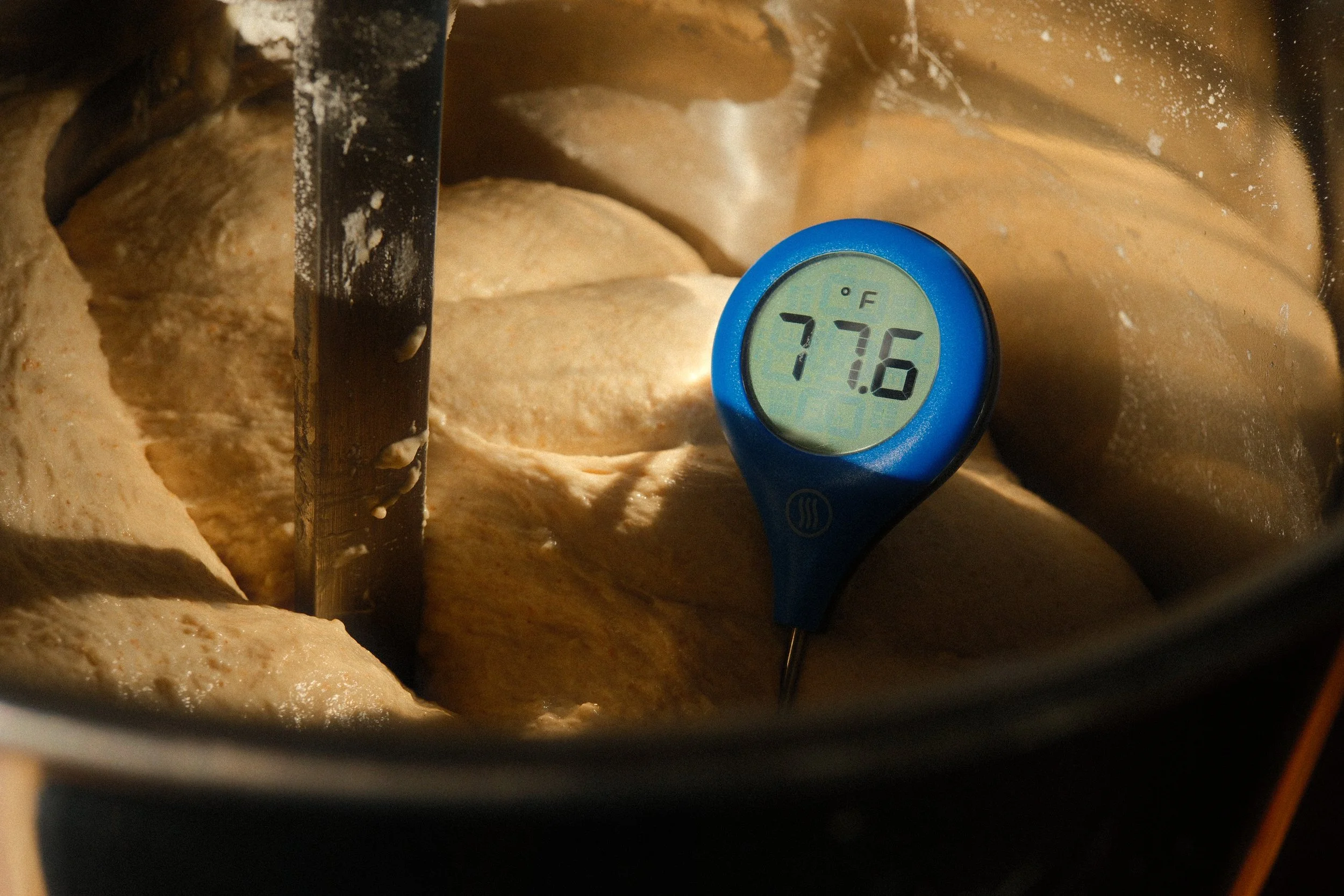
Admittedly, I still get lazy when it comes to temperature.
And end up paying for it.
It’s probably the un-sexiest aspect of bread making, and arguably the most important.
If you’re like me, the only time you really think about taking temperature is when you’re not feeling well, or to make sure you’re not eating raw chicken.
In bread making, temperature is everything.
Take a second and think about how small deviations in temperature affect—well—everything.
Water at 33ºF remains liquid, while dropping just 1º will turn that water to ice.
Someone who experiences an increase in body temperature only 1-2º will experience a fever.
A change in average earth temperature of 1-2º has global implications.
Bread is no different.
Every aspect of timing in a bread formula is based on temperature.
It’s meaningless to discuss how long to ferment or retard or bake without asking at what temperature?
Temperature tells you how fast—or slow—your dough progresses.
It’s kind of like asking how long it will take to drive across town.
It depends on how fast you drive.
Temperature is how fast your dough is moves.
If you’re struggling with consistency in your baking, or unable to troubleshoot why your bread isn’t turning out as it should, it’s worth wondering if you are being as diligent with temperature as you should.
I have thermometers everywhere.
Here’s a list of all the temperatures I need to know, not one of them is irrelevant:
Room temp.
Flour temp.
Preferment temp.
Water temp.
Dough temp (at least 3 times in the process).
Refrigerator temp.
Oven temp.
The more I can know about temperature, the greater control I have.
The key to consistent baking is hitting the desired dough temp as early as possible, and maintain it.
If I’m off, I make adjustments as possible.
I also keep a mixing log.
It allows me to track temperature and, over time, creates an historical record I can refer to in order to compare today’s conditions with similar past conditions and the temperatures needed to hit the correct DDT.
There are calculators which get you close to the DDT, but experience it what nails it.
Sometimes you hit the mark, sometimes you miss—and need to adjust.
One of the main reasons I prefer using an autolyse or bassinage is the opportunity to correct my DDT.
A proofing box gives me the ability to dial in an exact temperature, but even then things can get off. Ambient temperature can have great influence on your dough even when using a proofing box.
If I’m just baking a single loaf for my family, I tend to test my intuition and rely less on a thermometer, but if learning a new bake or baking for production—I want precision.
A word of advice: be conservative when mixing for your DDT.
I’d rather undershoot the temperature than overshoot it.
It’s easier to increase fermentation than to try to slow it down.
You can always ferment longer, but you cannot reverse it.
It’s a one way road.
In addition to speeding up fermentation, dough which is too warm can be difficult to shape as it becomes more extensible and sticky.
If you are short on time, don’t try to speed things up by increasing the temperature beyond the recommended DDT.
Rush, and you lose.
Instead, consider adjusting your inoculation percentage or adding a small amount of commercial yeast.
A few temp tips for precision baking:
Maintain your starter at a specific temperature, around the clock (I use a starter home).
If you can’t tend to your starter, make a stiff starter and refrigerate it.
Fermentation begins the minute you mix in your starter, and ends around midbake.
If retarding, it will take many hours for your dough to drop to the temp of your refrigerator.
As the temp drops, fermentation slows, but does not stop until it reaches about 39ºF.
Buy bluetooth thermometers to place in various areas to track temperature.
Opening the fridge regularly will prevent the temperature from getting as low as you might want.
If your loaf comes out of the fridge lifeless—or like it shrunk—your fridge might be too cold, but will still bake up nicely.
When baking, heat is your friend.
Don’t trust your oven’s built-in thermometer. Purchase an oven-safe thermometer.
Most home ovens say they are “ready” before they reach the set temperature.
The longer it heats, the better it will retain the heat when you open the door and place a cold loaf in.
The more loaves you load, the longer you’ll want your oven to pre-heat.
Temperature is key.